Reactive Group Solid State Disks Ltd SCSIFLASH Arraid, LLC SCSI SDD

Blog

Star InactiveStar InactiveStar InactiveStar InactiveStar Inactive

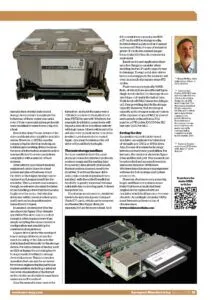
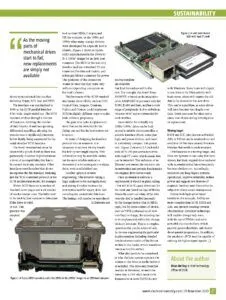
Aerospace Manufacturing January 2024 Article in print Copy Page 4 212x300

Reproduced here with the kind permission of the Editor of Aerospace Manufacturing.
Article in Aerospace Manufacturing, January 2024 issue. View pdf of the article here

Solid-state-based emulators are increasingly replacing floppy drives and other yesteryear storage technologies. Brian McSloy explains how solid-state-based swap-in drives are keeping host system operational and delivering new features.

The aerospace and defence sectors are renowned for the length of service systems and platforms must provide. Not surprisingly there are computer-based systems such as flight simulators, radar systems and automatic test equipment (ATE) stations in service today that were built more than 40 years ago.

Many of these systems were designed to use removable media such as magnetic (floppy) disks, magneto-optical (MO) disks or magnetic tapes. For example, some airlines are currently using Airbus A320 aircraft that had their maiden flights back in the 1980s, when floppy disk was the primary means of data transfer.

These old-technology drives all have moving parts that, over the years, have worn. Their failure might be imminent, potentially resulting in considerable problems when the host system loses its ability to read or write data.

Unfortunately, new replacements are obsolete; superseded years ago by newer technologies such as SD card and USB. Even early generation hard disk drives (HDDs) are now obsolete.

However, it is not just that the original storage devices have become obsolete. Alternatives that use the same physical interfaces are not available either. For example, an extremely popular way of connecting computer peripherals in the 1980s (and through to the early 2000s) was the small computer system interface (SCSI, “scuzzy”). It was standardised in 1986 as the SCSI parallel interface (SPI) 8-bit wide, single-ended bus. The standard evolved through a number of iterations, doubling the number of data lines to 16 and incorporating differential signalling (allowing the transfer rate to significantly increase) before finally being superseded by the serial attached SCSI (SAS) interface.

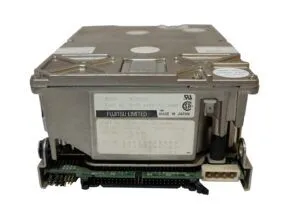
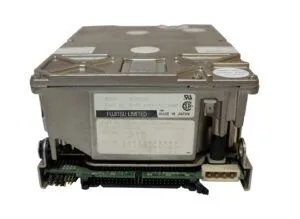
Many data storage device types – including floppy, MO, tape and HDD – adopted SCSI. However, above, the word ‘standardised’ must be taken with a pinch of salt because OEMs did not always implement the full standard. For example, they often retained just the SCSI command protocol or the SCSI architectural model. Moreover, many SCSI drives were designed with a specific host in mind, and the latter would only interface with that exact model number (see figure 1).

Fig 1 Fujitsu 300x219 1
Figure 1 – Above, this Fujitsu SCSI HDD was manufactured in the 1990s to fit a 1980s design for an IBM host computer. The drive has a standard 50-pin connector for data and control, and a 4-pin Molex connector for power. However, the positions of the connectors are such that they will mate only with corresponding connectors in the host’s chassis.

The unavailability of a new or reconditioned drive need not mark the end of the hosts system’s life, though.

Emulation

A number of companies are specialising in the design and manufacture of solid-state-based storage devices that can replicate the behaviour of these yesteryear units, even if their communications protocols were modified to make them unique to a host.

How is this done? Some details of the drive and its interface might be available online. However, in Solid State Disks Ltd’s (SSDL’s) case the company had to develop techniques to interrogate working drives because the level of information available online was insufficient to create emulations compatible with a number of host systems.

Alternatively, specialised analysis equipment can be taken to a host system and placed between it and the drive so that signal timings can be captured and programmed into the emulator. This is a worst-case scenario though, as extreme care must be taken when handling a drive that has become fragile over the years – but which is still in use within a host, is relied upon and there’s no backup/alternative immediately to hand.

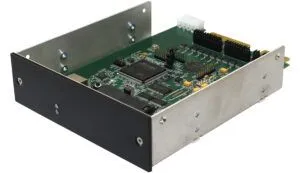
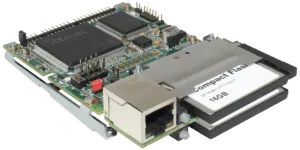
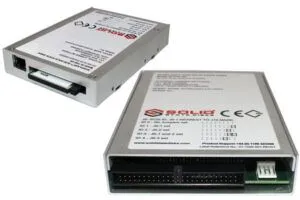
In essence, an emulator (like the one shown in Figure 2) for virtually any 1980s/90s drive can be created though it often requires more than simply adopting the same connector configuration and emulating the communication protocol.
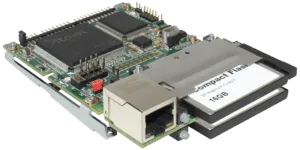
Fig 2 Emulator 300x150 1
Figure 2 – Above, a solid-state-based SCSI drive with dual CF cards.

Legacy drives are for the most part based on logical blocks, where the exact encoding of the data onto the disk is handled internally by the storage device. For some classes of device, such as ESDI or floppy, the encoding has to be implemented within the storage device’s firmware. This is a complex operation that can only be achieved by reverse engineering the particular implementation, including a detailed low-level examination of the format written to the media (which sometimes varies across the surface).

Also, the emulator may need to be formatted – in much the same way a USB stick needs to be formatted to at least FAT32 for use with Windows, for example. In addition, some hosts will expect a new drive to be filled entirely with logic zeros. Others will require the old data to be present on the new drive, in which case it needs to be copied. Again, care must be taken as the old drive will most likely be fragile.

The New Storage Medium

Because emulators have the same physical connector, interface protocols, memory maps and formatting (and if necessary, data already preloaded), the host system does not need to be modified. It will treat the new drive as if a replacement original had been installed, with the added benefit that reliability is greatly improved because solid-state has no moving parts. It draws less power too.

The storage media used in emulators tends to be industrial grade Compact Flash (CF) cards, which can be removed and treated like floppy disks, for example, but are far more robust. And if the emulator is replacing an HDD, a CF card is still the storage media; hidden behind a plate so that it cannot be removed. Note, the use of industrial grade CF cards also assures longer-term availability than its commercial equivalent.

Based on the end application there are a few things to consider when deciding on the CF card’s capacity and technology. Though solid-state drives have no moving parts, the memory will wear as a result of program-erase (PE) cycles.

Flash memory is typically NAND flash, of which there are different types. Single-level cell (SLC) technology stores one bit per cell and is the fastest type. Multi-level cell (MLC) stores two bits per cell, thus providing double the storage capacity. However, that doubling of capacity and a cheaper memory comes at the expense of speed (MLC is slower) and a greatly reduced (circa 30x) number of PE cycles; 100,000 for SLC but only 3,000 for MLC.

Saving the Day

As mentioned, a solid-state-based emulator can replicate the behaviour of virtually any 1980s or 1990s drive. Also, the use of modern technology introduces many new possibilities. For instance, the emulator shown in Figure 2 has an Ethernet port. This means it can be networked and accessed remotely; and some emulator OEMs have Windows-based memory management software for hot-backups and system recovery etc.

However, obsolescence is a moving target, and there are systems in use today that have already had their original drives replaced with an emulator which itself has since become obsolete. Accordingly, emulator OEMs must themselves keep on top of obsolescence.


Media contact:

Amanda Warrilow, Communications Officer

Email: This email address is being protected from spambots. You need JavaScript enabled to view it.

Tel: +44 (0)1522 789000

Star InactiveStar InactiveStar InactiveStar InactiveStar Inactive

south2024logofinal
Reading, United Kingdom –Solid State Disks Ltd (SSDL), the advanced storage systems design, development and integration specialist, is pleased to announce that the company will be exhibiting at Southern Manufacturing & Electronics, 6th – 8th February 2024, at the Farnborough International Exhibition Centre.

On stand C25, SSDL will be showcasing a wide range of memory solutions from its suppliers Innodisk, Transcend and Western Digital / SanDisk and technical specialists will be on hand to advise visitors on memory selection and explain the variety of services the company offers to support engineers, manufacturers and purchasers. For example, the close relationship SSDL enjoys with its suppliers, and other manufacturers, enables the company to offer direct pricing, support variable demand and even lock down BOMs.

“We’re looking forward to Southern Manufacturing & Electronics, and we’re confident that every visitor to our stand will learn something,” said James Hilken, Sales Director of SSDL. “As an OEM of products ourselves, we are wholly empathetic to the needs of designers, manufacturers and purchasers. This means visitors to our stand can meet with the people most qualified to give advice.”

SSDL also be using Southern Manufacturing & Electronics to formally launch its much-anticipated SCSIFlash3 drive.


About SSDL

Established in 1989, Solid State Disks Ltd (SSDL) is the industrial division of the Reactive Group of companies and specialises in the design, development and integration of advanced storage systems for mil/aero, commercial and industrial applications as well as the distribution of solid-state Flash memory and DRAM technologies.

For further information, please visit: www.solidstatedisks.com

All trademarks are recognized and are the property of their respective companies.


Media contact:

Amanda Warrilow, Communications Officer

Email: This email address is being protected from spambots. You need JavaScript enabled to view it.

Tel: +44 (0)1522 789000
Star InactiveStar InactiveStar InactiveStar InactiveStar Inactive

Article in Electronics Weekly, in the 29th November 2023 issue.

View pdf of the article here  Electronics Weekly 2023 11 29 issue – 26, 27

Reproduced here with the kind permission of the Editor of Electronics Weekly.
When a decades-old system is still heavily relied upon, but its now-obsolete storage device fails, what is the best course of action? Brian McSloy, Chief Technology Officer of Solid State Disks Ltd advocates the use a solid-state-based emulator and explains what’s involved in making one.

Data storage media such as magnetic (floppy) and magneto-optical (MO) disks, magnetic tapes and even early HDDs are, from a technical industry viewpoint, things of the distant past. However, many systems that were designed in that distant past, incorporating then state-of-the-art storage devices and media, are still in use today and must provide several more years of service.

For instance, in the military and aerospace sectors, radar systems, simulators, automatic test equipment (ATE) and computers are in use that were built more than 40 years ago and are based on pre-PC mini-computers and industrial computers. Also, some airlines are using Airbus A320 aircraft that had their maiden flights back in the 1980s, when floppy disk was the primary means of data transfer.

In the telecoms sector, legislation mandates that legacy services must continue to be offered, regardless of their commercial viability. Accordingly, digital access cross-connect systems (DACs), private automatic branch exchanges (PABXs) and other infrastructure from the 1980s and 1990s must remain operational. An example of perhaps the most ironic continued use of yesteryear data storage technology is within the semiconductor industry, where some fabs use tools that accept file transfers (for process recipes, for instance) only by floppy disk.

Where the removable media is concerned, some types are still available, albeit increasingly hard to come by. For example, the last manufacturer of 3.5” floppy disk media called it a day back in 2010. But that is not the main problem. With their moving parts, it is the mechanical drives themselves that start to fail. New replacements are simply not available and refurbished second-hand drives, when they can be found, carry short warranties. Moreover, it is not just that the original storage devices have become obsolete, alternatives that use the same physical interfaces are not available either.

In the interests of sustainability and keeping the host system operational for as long as possible, the practical solution is to replace the failing storage device with an emulator, a solid-state-based drive that uses the same physical connector, interface protocols and memory maps as the failing drive. Taking the swap-in replacement route means the host system needs no modifications and being solid-state, reliability is greatly improved (and with a lower power requirement). Also, if fitted with an Ethernet port, the new drive can be networked which opens a whole new world of possibilities.

As for the choice of storage media to use in the emulator, an industrial class Compact Flash (CF) card is the ideal choice, particularly where the end application still requires the memory to be removed.

Why industrial CF? It provides high endurance and longer-term availability than its commercial equivalent. Based on the end application (i.e., how the host system will be using the drive) other considerations include capacity, performance and memory wear. For instance, multi-level cell (MLC) is higher capacity but slower and has less endurance than single-level cell (SLC). That said, memory access will still be faster than with the old drive. As it is program-erase (PE) cycles that cause Flash memory wear, the correct selection of CF card is important, with the choice mainly dependent on the write frequency and the required device capacity.

Copy That

An extremely popular way of connecting computer peripherals in the 1980s through to the early 2000s was the small computer system interface (SCSI, “scuzzy”). Many storage device types adopted this interface including floppy, MO, tape and HDD.

The SCSI interface was standardised in 1986 as the SCSI parallel interface (SPI) 8-bit wide, single-ended bus. The SCSI standard evolved through a number of iterations, doubling the number of data lines to 16 and incorporating differential signalling, allowing the transfer rate to significantly increase, before finally being superseded by the serial attached SCSI (SAS) interface.

Also, the word ‘standardised’ must be taken with a pinch of salt as there was, particularly in earlier implementations, a level of incompatibility that has to be catered for in any emulator. Other interfaces were launched that do not incorporate the full standard, retaining just the SCSI command protocol or the SCSI architectural model, for example.

Within SCSI there are a number of standard mode pages and a set number of vendor unique ones. The latter tend to be used by host systems to determine if the drive is valid or not. Host system OEMs like Compaq and HP were heavily into this practice in the ‘80s and ‘90s. Indeed, many storage devices were developed for a specific host’s chassis. Figure 1 shows a Fujitsu HDD manufactured in the 1990s to fit a 1980s design for an IBM host computer.

Fig 1 Fujitsu 300x219
Figure 1 – Above, this Fujitsu SCSI HDD is the size of a shoebox and has a standard 50-pin connector for data and control, and a four-pin Molex connector for power. The positions of the connectors would be such that they mate only with corresponding connectors in the host’ chassis.

This looseness of the SCSI standard also meant drive OEMs, such as CDC Control Data, Seagate, Quantum, Fujitsu and Connor, could implement SCSI in slightly different ways to make their solutions proprietary.

As mentioned, the goal is to make a replacement drive that can be switched for the failing one and for the host system not to notice.

In terms of designing the interface protocol into an emulator, there is the issue of accounting for any tweaks the host system might require. This information may be available online, but the most reliable method to determine it is to interrogate a working drive, even a refurbished one will do provided it is a similar model.

In the absence of information or an identical or similar drive, one option is reverse engineering: taking a logic analyser to the end application and placing it in-line between the host system and the legacy drive and recording the control and data lines. The timings will need to be reproduced in firmware and in this respect microcontrollers (MCUs) are available that lend themselves well to the task. For example, a highly capable MCU is the Atmel SMART SAM9XE which is based on the integration of an ARM926EJ-S processor with fast ROM, RAM and Flash, and has a wide range of peripherals. It also embeds an Ethernet MAC and a MultiMedia/SD Card Interface.

An emulator for virtually any 1980s/90s drive can be built around a suitable MCU, a suitable interface driver, some glue logic and power devices, and result in a relatively compact, low-power unit. Figure 2 shows a 2.5” solid-state SCSI (50-pin connector) drive with dual CF cards, which means data can be mirrored.

Fig 2 Emulator 300x150
Figure 2 – A solid-state-based SCSI with dual CF cards. The inclusion of an Ethernet port means the emulator can be networked and provide functionality the original drive never could.

Once an emulator exists as a replacement it should be plain sailing. But will it though? Legacy drives are for the most part based on logical blocks, where the exact encoding of the data onto the disk is handled internally by the storage device (HDD, tape, etc.), but for some classes of device, such as ESDI or floppy, the encoding has to be implemented within the storage device’s firmware. This is a complex operation that can only be achieved by reverse engineering the particular implementation, including detailed low-level examination of the format written to the media, which sometimes varies across the surface.

What also needs to be considered is what the host system expects to be written to the drive or media before it is installed. In other words, the drive may need to be formatted, in much the same way a USB stick needs to be formatted to at least FAT32 for use with Windows. Also, some hosts will expect a new drive to be filled entirely with logic zeros. Other hosts will require the old data to be present on the new drive. This can be a problem, as some drives will have become very fragile over the years. Great care must be taken not to cause loss of data during investigation or replacement.

Moving Target

Above we have mainly discussed SCSI, but ESDI and IDE were also popular interfaces in the ‘80s and ‘90s. Thankfully, these can be emulated too and emulator OEMs like SSDL have created firmware libraries that reside in each emulator.

However, obsolescence is a moving target, and there are systems in use today that have already had their original drive replaced with an emulator which has subsequently become obsolete too. Accordingly, emulators can keep legacy systems operational, improve reliability, reduce power and support new features if required, but they must themselves be subject to obsolescence management. Making an emulator to replicate exactly the behaviour of a yesteryear technology drive, which was probably paired to a specific host, is not without its challenges or rewards.


Media contact:

Amanda Warrilow, Communications Officer

Email: This email address is being protected from spambots. You need JavaScript enabled to view it.

Tel: +44 (0)1522 789000
Star InactiveStar InactiveStar InactiveStar InactiveStar Inactive

Reading, United Kingdom –Solid State Disks Ltd (SSDL), the advanced storage systems design, development and integration specialist, has developed procedures that enable its popular solid-state SCSI Flash drive to emulate the 12 TEAC FD-235HS, 3.5-inch double-sided 5.3 track/mm (135tpl) micro floppy drive, known within the industry as the FC1.

Micro floppy disks were available in 1 and 2MB capacities, in either single (SD) or high density (HD) formats and the drives interface with their host via SCSI.

“We’re pleased to add the TEAC FC1 micro floppy disk drive to our growing list of emulation capabilities,” said James Hilken, Sales Director of SSDL, “as it reinforces the versatility of our highly reliable and cost-effective SCSIFlash technology.”

SSDL’s SCSIFlash supports 12 fixed FC1 emulations and one variable emulation that can be configured by the host using the SCSI MODE SELECT command.

Any routines that users have in place involving backing up to micro floppy disks – or using them for system restoration – can be followed using Compact Flash (CF) cards instead.

SSDL Web Images 44 300x213

A pdf revision of our Teac FC1 Application Note is available to download.


About SSDL

Established in 1989, Solid State Disks Ltd (SSDL) is the industrial division of the Reactive Group of companies and specialises in the design, development and integration of advanced storage systems for mil/aero, commercial and industrial applications as well as the distribution of solid-state Flash memory and DRAM technologies.

For further information, please visit: www.solidstatedisks.com

All trademarks are recognized and are the property of their respective companies.


Media contacts:

James Hilken, Sales Director, Solid State Disks

Tel: +44 (0) 1189 323499. Email: This email address is being protected from spambots. You need JavaScript enabled to view it.

Amanda Warrilow, Communications Officer

Email: This email address is being protected from spambots. You need JavaScript enabled to view it.

Tel: +44 (0)1522 789000
 

Star InactiveStar InactiveStar InactiveStar InactiveStar Inactive

Reading, United Kingdom –Solid State Disks Ltd (SSDL), the advanced storage systems design, development and integration specialist, has won a contract from EDF Energy to design and supply solid-state swap-in replacements for a number of obsolete CDC 182MB Wren hard disk drives. These will replace drives currently used in a Bull DPS6 computer at the company’s Heysham 2 nuclear power station on the northwest coast of England, and spare EDF energy from the considerable expense of replacing the host system.

The original Wren drives interface with the host system using the legacy American National Standards Institute’s (ANSI) Enhanced Small Disk Interface (ESDI) standard X3.170, which was popular in the late 1980s. SSDL will design a solid-state, flash-based drive that will be configured to emulate the behaviour of the original drive and communicate with the Bull DPS6 through ESDI. No changes will need to be made to the computer.

“ESDI had a relatively short life as an interface, as it had no sooner been standardised than it was superseded by ANSI’s Small Computer Systems Interface, SCSI,” explains James Hilken, Sales Director of SSDL. “In the past, we have supplied many solid-state replacements for SCSI-based drives, and still do, but in this instance we’re going to design an ESDI-based drive to meet EDF Energy’s immediate requirements.”

SSDL plans to base its new design on elements from its popular SCSI Flash (SF-2) and Floppy Flash (FF-1) products and will be designing new hardware (printed circuit board, PCB), firmware (in a field programmable gate array, FPGA) and software.

Hilken concludes: “There are essentially two halves to our emulator solutions, the solid-state Compact Flash part and a communication bridge. SCSIFlash is the bridge in our SCSI-based products, and the work ahead will effectively result in a new ESDIFlash bridge, which will then enable us to make available emulators for anyone else in need of replacing their obsolete ESDI-based drives.”

In addition to extending the life of its Bull DPS6, EDF Energy will also benefit from the high reliability of solid-state memory technology. Unlike a hard disk drive, there are no moving parts. Also, power consumption and heat generated are lower.


About SSDL

Established in 1989, Solid State Disks Ltd (SSDL) is the industrial division of the Reactive Group of companies and specialises in the design, development and integration of advanced storage systems for mil/aero, commercial and industrial applications as well as the distribution of solid-state Flash memory and DRAM technologies.

For further information, please visit: www.solidstatedisks.com

All trademarks are recognized and are the property of their respective companies.


Media contacts:

James Hilken, Sales Director, Solid State Disks

Tel: +44 (0) 1189 323499. Email: This email address is being protected from spambots. You need JavaScript enabled to view it.

Amanda Warrilow, Communications Officer

Email: This email address is being protected from spambots. You need JavaScript enabled to view it.

Tel: +44 (0)1522 789000
Contact

Arraid, LLC
26 W Lone Cactus #500,
Phoenix,
AZ 85027
Email: sales@arraid.com
UK & Rest Of World: +44 (0) 1189 323 499
USA West Coast: +1 (480) 699 3047 (Sales & Manufacturing)
USA East Coast: +1 (703) 503 8200 (Sales)

Copyright © Arraid, LLC - Reactive Group 1999 - 2025. All Rights Reserved.

Search